The closure on a boba cup is an operating decision, not an afterthought. It determines whether a drink survives a delivery bag, how fast your staff can clear a queue, whether the lid carries your logo, and what you spend per cup over a year. There are two families to choose between: a heat-sealed film pressed across the rim, or a snap-on dome or flat lid. Which one fits depends less on taste than on how you actually serve drinks.
Heat-sealed film: what it buys you
A heat sealer presses a printed film across the cup rim and bonds it under heat, producing a flat, drum-tight top that a straw punches through. The advantages are concentrated wherever drinks travel. A sealed film is genuinely leak-proof, so a cup can lie on its side in a delivery bag without dumping tapioca and tea, which is the single biggest reason bubble tea shops adopt sealing. It is tamper-evident, because the customer can see the seal is intact and unbroken. It is more hygienic, since no hand touches the drinking surface between the machine and the customer. And the film itself is prime branding space, so a custom-printed film turns every cup into a logo. The trade-offs are that a seal is not resealable, since once the straw is in the cup is open for good, and that film requires a machine, counter space, and a few seconds per cup, which matters during a rush.
Snap-on lids: where they still win
Snap-on lids, whether flat sip lids or domes for topped drinks, remain the right answer in several situations. They need no equipment, so a pop-up, a caterer, or a low-volume cafe can serve without buying and maintaining a sealer. They are resealable, which suits a customer nursing a drink at a table or walking with it. Domes make room for tall toppings, whipped cream, or a presentation that a flat seal would crush. And they are instant, with no warm-up and no per-cup machine time. The cost is real, though: a snapped lid can pop or leak if a bag tips, and it offers no tamper evidence, both of which matter more the moment a third-party courier is carrying the drink to someone you will never see.
Match the closure to how you serve
The decision falls out of your service model. A shop doing heavy delivery and third-party app orders should treat sealing film as the default, because leak-proofing and tamper evidence are exactly what those channels punish you for lacking. A high-volume walk-up window benefits from film paired with an automatic sealer that can keep pace with the line. A dine-in-focused cafe with light takeout can run snap-on lids comfortably and skip the machine entirely. Events and catering usually favor film for anything transported and lids for a stationary drink station. Most established shops end up running film as the primary closure for cold drinks and keeping lids on hand for domed or specialty items, so the practical question is rarely film or lids in the abstract, but which is primary for your busiest channel.
Specifying the film: material and diameter
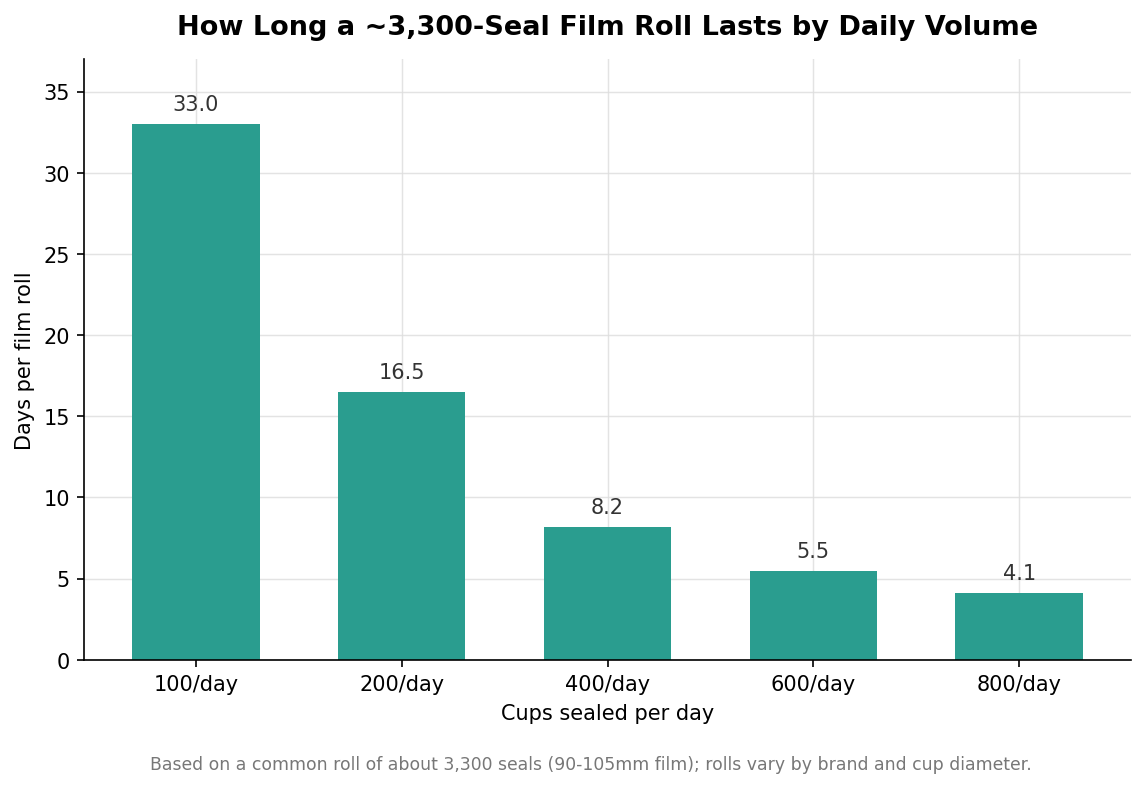
Film is not interchangeable, and the two things to get right are material and diameter. Match the film to the cup: PP film bonds only to polypropylene cups but forms a strong, permanent seal; PET-ES film is the most versatile, sealing PP, PET, paper, foam, and most PLA cups; PE-based films suit PE-coated paper cups with a lighter, peelable bond; aluminum-foil films cover a broad 60 to 100 mm range; and PLA-based films exist for shops running a fully compostable program. If your cups are compostable, the film has to be too, or the whole cup ends up as landfill. Diameter is the unforgiving part: boba cup rims commonly run 90, 95, 98, or 100 mm, with 95 mm the typical PP boba size, and the film roll and the machine ring must match the rim exactly, or you get weak, wrinkled seals. A 90 mm cup can sometimes run on a 95 mm machine with an adapter ring, but matching from the start is cleaner. Rolls are sized in thousands of seals, since a common 90 to 105 mm roll runs on the order of 3,300 cups, so a little arithmetic against your daily volume tells you how often you will be swapping rolls and reordering.
Choosing and running the sealer
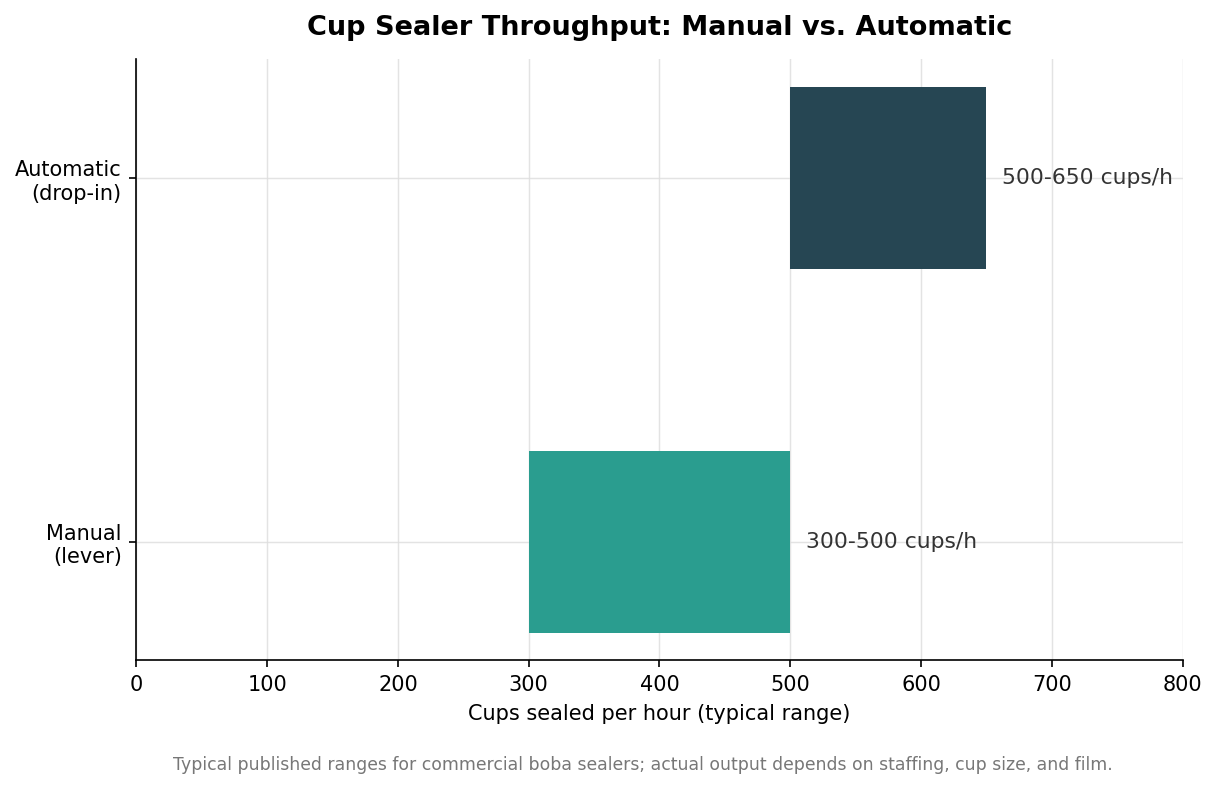
The machine sets your ceiling on speed and consistency. Manual sealers ask an operator to pull a lever for each cup and typically move somewhere around 300 to 500 cups an hour; fully automatic models detect the cup, seal, and eject on their own and push into the 500 to 650 range, which is the difference between keeping and losing a lunch rush. Whichever you buy, temperature control is what separates a clean seal from a failed one: each film-and-cup combination has its own correct temperature, and a machine that holds it steadily wastes fewer cups. Buy the sealer and the film as a system, meaning the same diameter, compatible materials, and the right temperature range, rather than sourcing a cheap film that fights your machine. Then keep a spare roll and a cleaning routine, because a sealer that jams mid-rush is worse than no sealer at all.
Closures look like a commodity and behave like one right up until a delivery order arrives leaking. Decide by channel: if drinks travel, lead with sealed film, spec the material and diameter to your cups, and size the machine to your busiest hour; if drinks mostly stay put, snap-on lids will serve you fine. Get that match right and the closure quietly does its job, which is all anyone should ever notice about it.