Custom boba cups look like a simple purchase: pick a size, drop in your logo, place the order. In practice the cup is a system that has to work with your sealing machine, your straws, your drink recipe, and a manufacturing timeline measured in weeks. Most of the expensive mistakes happen because a shop treats one of those pieces as an afterthought. Here are the five that cost bubble tea shops the most money and grief, and how to avoid each.
Choosing the plastic for price instead of the drink
Boba cups come in three main materials, and they are not interchangeable. PP (polypropylene) is the economical default, injection-molded, slightly hazy, and comfortable with warm and blended drinks. PET is glass-clear and rigid with a premium feel that shows off layered drinks and fruit, but it is a cold-only material that can distort or crack with heat. Paper cups serve hot drinks and shops chasing a lower-plastic image, at the cost of the see-through look boba is known for. The mistake is choosing on unit price alone and then discovering the cup does not suit what you actually pour. If you serve hot tea or blended slushes, PET will fail you; if crystal clarity is your brand, PP will look muddy. Material also drives wall thickness and rigidity, which is what makes a cup feel cheap or substantial in the hand, so request a physical sample in the exact size and material before committing rather than judging from a product photo. Match the material to the drink first, then compare prices within that material.
Overlooking rim diameter and sealer compatibility
This is the mistake that turns a pallet of beautiful cups into a pallet of unusable ones. Boba cups are built around a standard rim, most commonly 90mm or 95mm, and your sealing machine and film are set for a specific rim size. Order cups whose rim your sealer cannot accommodate, or film that does not match the cup, and you physically cannot seal the drink. Before committing to a custom run, confirm the cup rim, the range your sealing machine handles, and the film width, and make sure all three agree. If you run a lidded rather than sealed operation, verify that your dome or flat lids seat on that same rim. The rim is the one dimension where “close enough” means a failed seal on every cup.
Treating custom cups like a quick reorder
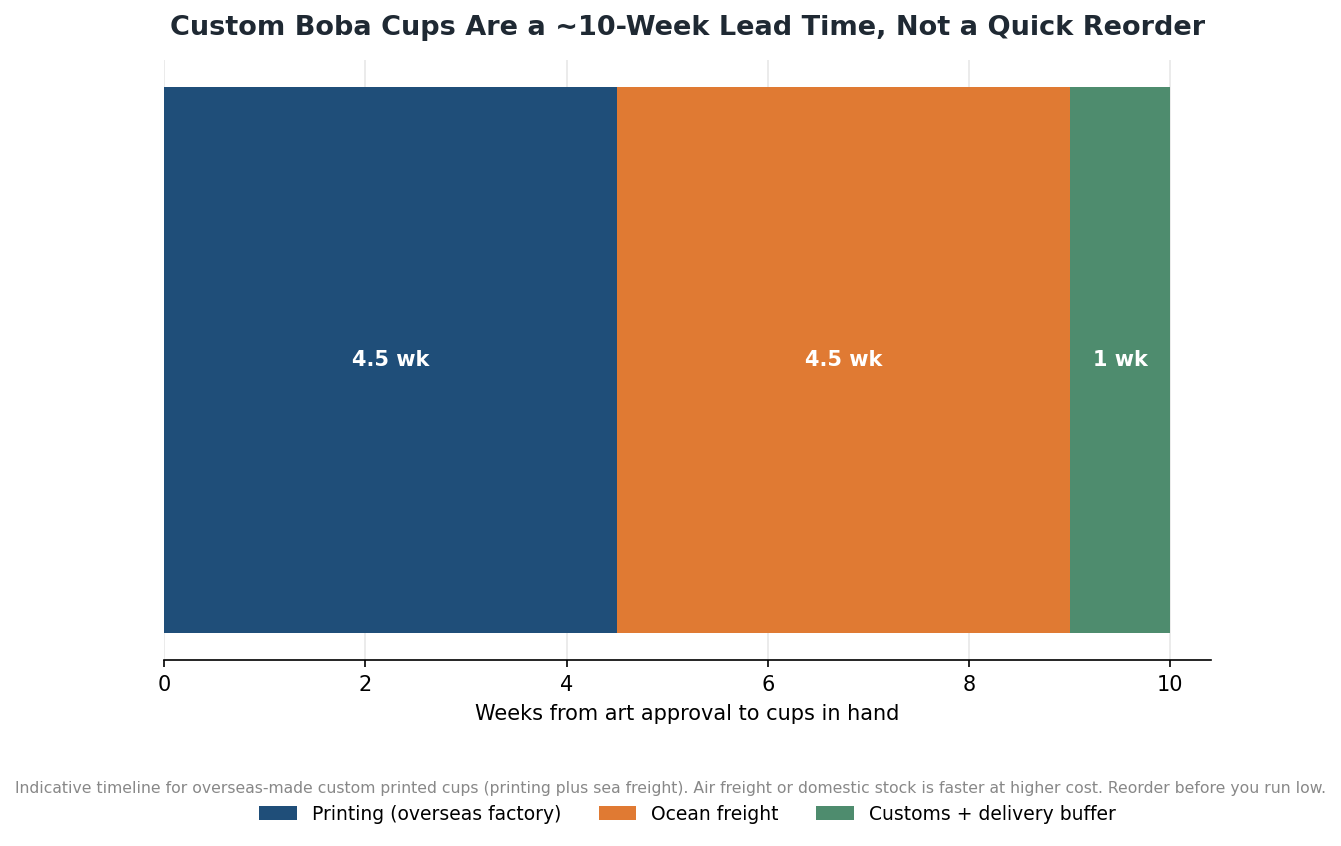
Stock clear cups arrive in days. Custom printed cups do not. They are typically manufactured overseas, and a realistic timeline runs about four to five weeks of printing plus four to five weeks of ocean freight, roughly eight to ten weeks door to door once customs and delivery are counted. Minimum orders are large too, often on the order of ten thousand cups per design and size, because the tooling and setup only make sense at volume. Shops that order reactively, when the stockroom is nearly empty, end up either paying for air freight or serving weeks of drinks in generic cups while the branded ones cross the Pacific. Build a reorder trigger well above zero and plan the next run a couple of months before you expect to need it.
Over-designing the artwork
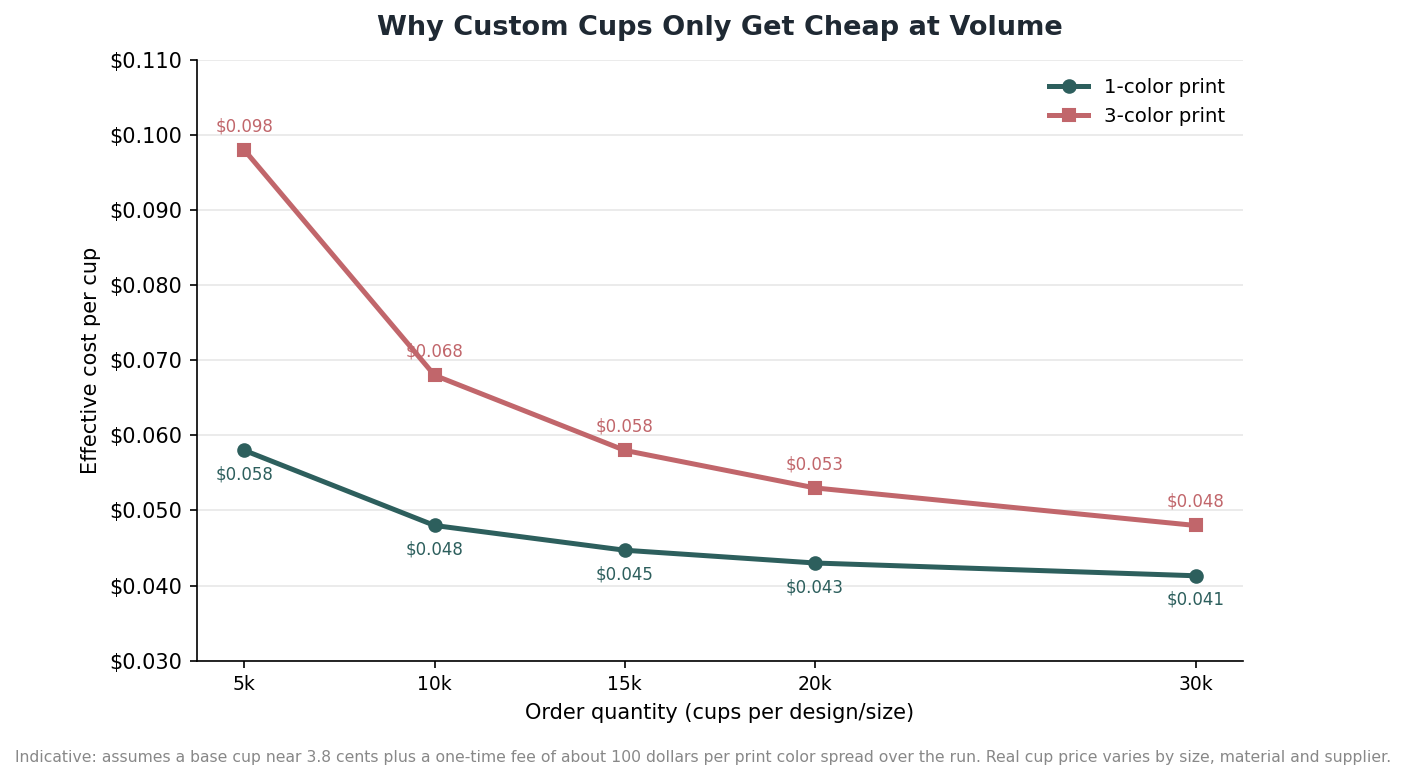
A cup is a small, curved, often translucent surface, and busy artwork fights all three of those facts. Each additional print color usually carries its own one-time setup or mold fee, commonly around a hundred dollars per color, so a four- or five-color design quietly inflates the bill before a single cup is made. Most suppliers recommend one to three colors, and there is a good reason beyond cost: fine text, thin lines, and subtle gradients lose definition on a rounded, semi-clear wall. The effective per-cup price also depends heavily on how many cups you spread those setup fees across, which is why the same design can feel cheap at thirty thousand cups and expensive at five thousand. Design bold, keep the color count disciplined, and remember that clear negative space on a boba cup reads as premium, not unfinished. It also helps to supply artwork as vector files with colors called out as specific Pantone references, so the factory reproduces your brand rather than approximating it, and to ask for a printed proof or a photo of a first-article cup before the full run is made.
Ordering the wrong sizes, and forgetting the pearls
Boba cups are sold by nominal volume, commonly 12, 16, and 24 ounces, but a boba drink is not just liquid. Tapioca pearls, ice, and toppings take up real space, so a drink built in a cup filled to its rated volume leaves no headroom for sealing and spills on the first sip. Shops that spec cup size purely off the drink’s liquid volume routinely end up a size too small. The related error is ordering a single size to simplify the run, then finding that customers want both a standard and a large, or that a seasonal blended line needs more room than the everyday milk tea. Because minimums and lead times apply per size, it pays to settle your size lineup before the first custom order rather than discovering the gap after ten thousand cups arrive. Leave headspace for pearls and ice, and lock your size mix up front.
None of these mistakes are exotic; they are the predictable result of treating a custom cup as a print job rather than a piece of operating equipment. Choose the material for the drink, confirm the rim against your sealer, respect the lead time and minimums, keep the artwork bold and few-colored, and size for a real boba drink with pearls and ice in it. Handle those five, and a custom boba cup becomes what it should be: a cheap, repeatable piece of branding that works flawlessly on every drink you serve.