If you’re pricing out custom boba cups for a new shop or a rebrand, the numbers online are all over the place — $0.04 a cup on one listing, $0.24 on another, “no minimum” on a third. That spread isn’t a typo. It comes down to material (PP or PET), cup size, print method, and whether the cups are made domestically or overseas. This guide walks through what custom boba cups actually cost right now, what minimum order quantity you should expect to hit, and how long you’ll actually wait between paying a deposit and having printed cups stacked behind your counter.
None of the figures below are estimates pulled from thin air — they’re taken from current supplier listings and quoted directly, with the source named so you can verify them yourself before you commit to a print run.
Source: Custacup.com; Gstar Packaging listing via Made-in-China.com; market survey of boba cup suppliers, accessed August 2026
What custom boba cups actually cost
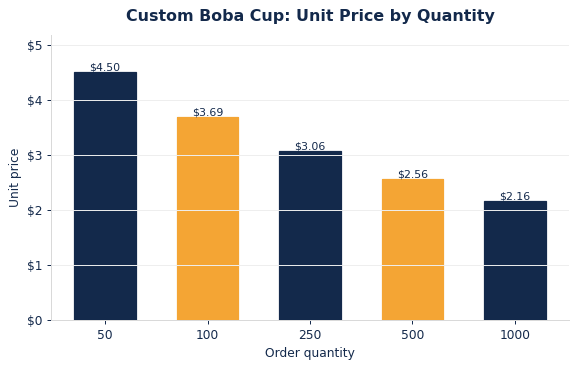
Per-cup pricing for custom boba cups depends on three things: the material, the quantity you order, and how many print colors you’re using. On the low end, PP boba cups from overseas manufacturers price out around $0.04 to $0.12 per cup at a 10,000-unit order, based on current listings from packaging supplier Gstar Packaging. That’s the price of the bare cup with full-color in-mold labeling — lids, straws, and sealing film are quoted separately.
Domestic printers charge more per cup but cut the wait. Custacup, a USA-based cup printer, runs a standard minimum of 7,000 printed cups per design plus a one-time setup fee of $150 per print color, rather than pricing purely per-thousand. Across the wider market, per-cup pricing for custom printed cups spans roughly $0.05 to $0.24, with the low end reserved for large runs of standard sizes and the high end for small runs, extra colors, or unusual shapes like heart-cut or U-shaped cups.
The practical takeaway: if your shop goes through fewer than a few thousand cups a month, you’re better off comparing total landed cost — cup price plus setup fee plus freight — rather than chasing the lowest sticker price per cup, since a cheap overseas cup with a long shipping leg can end up costing more once you factor in the wait and the freight bill.
| Supplier / material | MOQ | Price per cup | Setup / plate fee |
|---|---|---|---|
| PP cups — Gstar Packaging (12–22oz, full-color) | 10,000 cups | $0.04–$0.12 | — |
| Custom printed cups — Custacup (USA-printed) | 7,000 cups | Quoted per order | $150 per color |
| General market range — multiple suppliers | 5,000–30,000 cups | $0.05–$0.24 | $100 per plate/color/size |
Minimum order quantities: why 5,000 to 10,000 is the norm
Custom boba cups are made by injection-molding or thermoforming plastic around a printed label or plate, and that tooling only pays for itself at volume. That’s why almost no supplier will run custom boba cups below about 5,000 units, and most set their real minimum between 7,000 and 10,000. A few specialty shapes — heart-cut rims, U-shaped bodies, unusual ounce sizes — push minimums as high as 30,000 because the mold itself is non-standard.
If 7,000–10,000 cups sounds like a lot for a single-location shop, it usually isn’t as bad as it looks once you convert it to weeks of stock: a shop doing 300 boba drinks a day burns through 9,000 cups in a month. The bigger risk is ordering a print run before you’ve locked your final logo or menu — you’ll be serving that exact design for months.
PP cups: the low-MOQ option
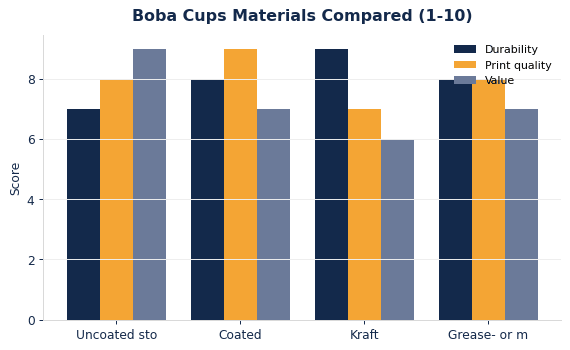
Polypropylene (PP) is the standard material for hot-and-cold boba cups because it tolerates heat, seals cleanly under a film-sealing machine, and is the cheapest plastic to mold. Suppliers consistently offer PP at lower minimums and lower per-cup prices than PET, which is why most shops start here.
PET cups: clearer walls, higher minimums
PET (the same plastic used in soda bottles) is glass-clear, which is why it’s the default for Instagram-friendly layered drinks. That clarity comes with a trade-off: PET cups typically carry higher minimums and higher per-cup pricing than PP, and they’re not rated for hot beverages.
Lead times: standard sizes vs. specialty shapes
Lead time is where custom boba cups most often derail a launch date. Standard sizes — 12, 16, 20, 24, and 32oz — are the sizes suppliers keep tooling on hand for, so they typically ship in 2–4 weeks from art approval. Step outside that range into the 3–14oz bracket, or ask for a shape that needs a new mold, and lead time stretches to 8–12 weeks.
Where the cup is printed matters just as much as the size. Cups printed and shipped from Taiwan or mainland China commonly need 5–6 weeks for printing plus another 5–6 weeks for ocean freight, putting total lead time at 10–12 weeks door to door. Domestic printers like Custacup quote 4–5 weeks from final design approval because there’s no freight leg — you’re paying a per-cup premium for that speed.
If you’re opening on a fixed date, work backward from the lead time, not the price. A cup that’s $0.03 cheaper per unit doesn’t matter if it lands six weeks after your grand opening.
| Cup size / origin | Typical lead time |
|---|---|
| Standard sizes (12, 16, 20, 24, 32oz) | 2–4 weeks |
| Less common sizes (3–14oz range) | 8–12 weeks |
| Overseas-printed cups, including ocean freight | 10–12 weeks total |
| USA-printed cups (Custacup) | 4–5 weeks from design approval |
Choosing between PP and PET for your shop
The material choice isn’t just cosmetic. PP is more durable and more heat-resistant, which is why it’s the recommended material for shops that serve hot bubble tea or use a heat-sealing machine on the rim. PET’s advantage is optical clarity — if your menu leans on layered, colorful drinks that customers photograph, the extra clarity can be worth the higher MOQ and price.
Most boba shops that serve both hot and cold drinks standardize on PP across their whole menu rather than stocking two cup materials, since running two SKUs doubles your minimum order exposure and your storage footprint.
Setup fees, print plates, and artwork files
Beyond the per-cup price, budget for a one-time setup charge. Suppliers quote this as a plate fee, a mold fee, or a per-color setup fee, and it typically runs $100 to $150 per color, per size. A two-color logo on a single cup size might cost $200–$300 in setup before a single cup is printed; add a second size (say, both 16oz and 22oz) and that fee doubles.
Most printers want vector artwork — AI, EPS, or a layered PDF — with fonts converted to outlines and each ink color separated. If your logo only exists as a PNG or a JPEG, expect the supplier to either charge a redraw fee or ask you to get it vectorized first. Sending clean files upfront is the single easiest way to avoid a week of back-and-forth proofing before production even starts.
How to order custom boba cups without overpaying
A few habits separate shops that get a good deal from shops that get stuck with 10,000 cups they didn’t need. First, size your order to your actual monthly volume — calculate daily cup usage and order enough for roughly two to three months, not a full year, since flavors, seasonal promos, and rebrands change faster than a giant print run can keep up.
Second, request physical samples before you approve a print plate. A screen proof doesn’t tell you how ink sits on a curved PP wall or how a color shifts once light passes through a filled cup. Third, if you’re ordering both cups and sealing film, buy them from the same supplier or confirm rim diameters match exactly — a film that doesn’t seal flush against the cup rim leaks, and you’ll find out mid-rush.
Finally, weigh price against lead time honestly. An overseas PP cup at $0.05 with 10–12 weeks of lead time is a good deal for a shop planning three months out. The same cup is a bad deal for a shop that needs product in three weeks — in that case, a domestic printer’s higher per-cup price is the cheaper mistake to avoid.
Frequently asked questions
What’s the minimum order quantity for custom boba cups?
Most suppliers set a minimum between 7,000 and 10,000 cups per design. A handful will go as low as 5,000, and specialty shapes (heart-cut rims, unusual ounce sizes) can push the minimum up to 30,000 because they require a dedicated mold.
How much do custom boba cups cost per cup?
Expect roughly $0.04 to $0.24 per cup depending on material, order size, and number of print colors. Large PP orders from overseas manufacturers land at the low end; small runs, extra colors, or domestic USA printing push toward the higher end. Add a one-time setup or plate fee of about $100–$150 per color on top of that.
How long does it take to get custom boba cups made?
Standard sizes (12–32oz) typically take 2–4 weeks with a domestic printer, or 10–12 weeks total if the cups are printed overseas and shipped by ocean freight. Less common sizes (3–14oz) can take 8–12 weeks even with a domestic supplier because of custom tooling.
Should I choose PP or PET for custom boba cups?
PP (polypropylene) is the standard choice — it’s cheaper, has a lower MOQ, tolerates hot drinks, and works with cup-sealing machines. PET is clearer and better for cold, layered drinks meant to be photographed, but it costs more, has a higher minimum, and isn’t rated for hot beverages.
Do custom boba cups need matching sealing film?
If you’re using a heat-sealing machine instead of lids, yes — the film needs to match your cup’s rim diameter (commonly 90mm or 95mm) to seal flush. Confirm this spec before ordering cups and film from different suppliers.
The bottom line
The fastest way to overpay for custom boba cups is to shop on price-per-cup alone. Once you factor in the minimum order, the setup fee, and the real lead time, a $0.05 overseas PP cup and a $0.15 domestic cup can end up costing about the same for a shop ordering on a normal three-month cycle — the difference is mostly about how far ahead you’re planning. Start by locking your final artwork as vector files, decide whether hot drinks make PP the only real option, and order enough to cover two to three months of use rather than a year’s worth of a design you might change.